Be yourself; Everyone else is already taken.
— Oscar Wilde.
This is the first post on my new blog. I’m just getting this new blog going, so stay tuned for more. Subscribe below to get notified when I post new updates.
Be yourself; Everyone else is already taken.
— Oscar Wilde.
This is the first post on my new blog. I’m just getting this new blog going, so stay tuned for more. Subscribe below to get notified when I post new updates.

The one day of the year surrounded by superstitions around the world is Friday the 13. It doesn’t matter the month, or year but it seems this day causes a lot of harm to people around the world. Take for example all of the tragedies that have occurred on Friday the 13th, throughout the world and the modern era. The bombing of Buckingham Palace during WW2, The Costa Concordia cruise ship sanking off the cost of Italy killing 32 people, and Swedish Flight DC-3 vanishing never to be heard from again. Each of these events have only one thing in common they each occurred on Friday the 13th. Where all of these events a coincidence ? Most people know that Friday the 13th is associated with atrocities such as these. Each year on this day, it seems that many more people will meet their demise. An estimated $700-800 million U.S dollars are lost on Friday the 13 each year as people have connected the dots to this mysterious date, and refuse to travel, conduct business, and buy basic necessitates. It is for these reasons why Friday the 13th is correctly associated with its superstitions regarding the loss of human life.

Harry Potter and the Deathly Hallows: Part 2 is a spectacular close to the franchise that we all know and love. This movie focuses on Harry’s final battle while also exploring his character’s emotional connection to the Weasly family, of whom have been a part of his journey since his first day at Hogwarts, after the shock of learning he was a wizard. Throughout Harry’s journey, the character Albus Dumbledore has hidden from him his past, and in this conclusion Harry learns the truth of what he must do, which is to walk into death’s loving and open arms. In this heart wrenching ending, the audience walks with Harry as he approaches his destiny and allows himself to be killed by Voldemort. According to Peter Bradshaw, “it is gripping and even moving when Harry realises what his destiny is, and sets out to fulfil it.” This insight to the movie is entirely accurate, as when the scene unfolds, the audience gets to explore Harry’s more emotional side that was not previously explored in the other seven films. Additionally, the audience learns of Snape’s role in Harry’s production, which helps offset the bias against Snape’s character built up over the other films. The scene when Snape is on his deathbed and giving his memories to Harry is touching to the audience, as we have experienced Harry’s hatred for Snape in previous films. This scene, according to Sandie Angulo Chen, “… [is] handled quite beautifully”, and develops Snape’s character into a more fulfilling role. Overall, Harry Potter and the Deathly Hallows: Part 2 further develops Snape’s character and Harry’s emotional side in a way that is satisfying for the audience. It is a good conclusion to the franchise, closing the chapter by closing the characters’ stories in an emotional epilogue.
Works Cited
Bradshaw, Peter. “Harry Potter and the Deathly Hallows:
Part 2 – Review.” The Guardian, Guardian News and
Media, 7 July 2011,
http://www.theguardian.com/film/2011/jul/07/harry-
potter-deathly-hallows-part-2-review.
Chen, Sandie Angulo. “Harry Potter and the Deathly
Hallows: Part 2 – Movie Review.” Common Sense
Media: Ratings, Reviews, and Advice, Common Sense
Media, 15 July 2011,
http://www.commonsensemedia.org/movie-reviews/harry-
potter-and-the-deathly-hallows-part-2.
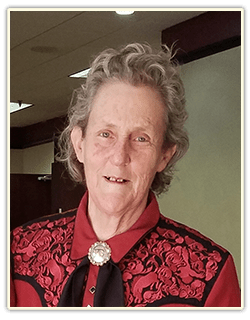
Temple Grandin, although autistic, communicates beautifully through design and innovation for animals. She is most famous for her revolutionary designs in cattle chutes to make them safer and more humane for animals. Grandin has a difficult time communicating with people, however this is more than made up for when her skill with animals is allowed to flourish. Grandin’s passion for animals leads to humane treatment, which is the more important aspect of working with bovine as compared to the satisfaction of the human handler. She took her revolutionary works to Colorado State University, where she is a professor of Animal Science and Behavior. She is one of the leading expert on animal behavior, specifically with livestock animals, is an autism spokesperson, and is one of the first people to document her insight from her experiences with autism. Grandin has successfully offered more than sixty peer reviewed scientific papers on animal behavior, and is a prominent voice for the humane treatment of livestock animals heading to slaughter. Grandin’s cattle chute designs made it possible for her to create a “hug box” to calm those on the autism spectrum. Her works have earned her a spot on the “100 most influential people in the world”. She was named a hero by the Emmys and Golden Globes, winning semi-biological film for the “Temple Grandin” movie. Grandin’s extensive knowledge, reliable work, and respectable interactions with animals has led to the creation of many revolutionary cattle chute designs in our world today. Additionally, Grandin’s knowledge of design and conceptual ability to revolutionize traditional methods has led to the improved humane treatment of livestock animals. Not only is her work important, but necessary for the humane treatment of livestock animals as well as the safety of their handlers and satisfaction of the consumers.
This is an example post, originally published as part of Blogging University. Enroll in one of our ten programs, and start your blog right.
You’re going to publish a post today. Don’t worry about how your blog looks. Don’t worry if you haven’t given it a name yet, or you’re feeling overwhelmed. Just click the “New Post” button, and tell us why you’re here.
Why do this?
The post can be short or long, a personal intro to your life or a bloggy mission statement, a manifesto for the future or a simple outline of your the types of things you hope to publish.
To help you get started, here are a few questions:
You’re not locked into any of this; one of the wonderful things about blogs is how they constantly evolve as we learn, grow, and interact with one another — but it’s good to know where and why you started, and articulating your goals may just give you a few other post ideas.
Can’t think how to get started? Just write the first thing that pops into your head. Anne Lamott, author of a book on writing we love, says that you need to give yourself permission to write a “crappy first draft”. Anne makes a great point — just start writing, and worry about editing it later.
When you’re ready to publish, give your post three to five tags that describe your blog’s focus — writing, photography, fiction, parenting, food, cars, movies, sports, whatever. These tags will help others who care about your topics find you in the Reader. Make sure one of the tags is “zerotohero,” so other new bloggers can find you, too.

 Cerebrum